‘My Sassy Girl’ Returns in 4K for 25th Anniversary on Nov 20
A quarter-century after its debut, My Sassy Girl remains a reference point for the Korean romantic comedy.
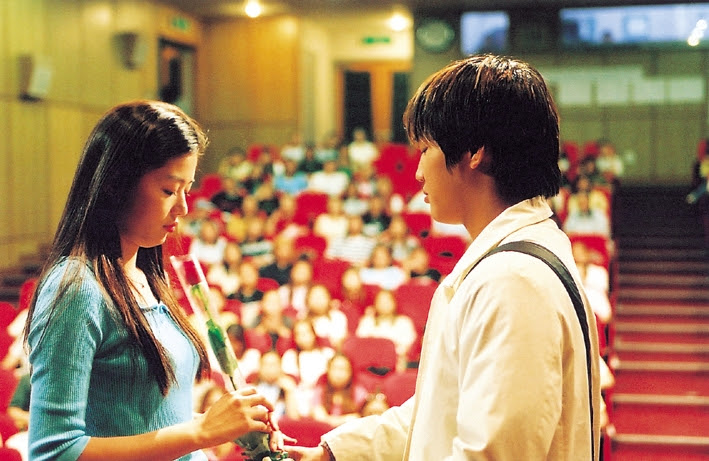
LOS ANGELES: South Korean romantic comedy My Sassy Girl, which became a major box-office success across Asia and helped introduce Korean cinema to a wider international audience, will receive a 4K restoration for its 25th anniversary, with a digital release scheduled for November 20.
The restoration, made from the film’s original negative, will be available through video-on-demand services and leading digital platforms, according to distributor Film Movement. Directed by Kwak Jae-yong and starring Jun Ji-hyun and Cha Tae-hyun, the 2001 film became a box-office phenomenon across East Asia and helped introduce a wider international audience to South Korean popular cinema.
Its return comes as Korean entertainment has become a global cultural force, driven by the international success of K-pop, television dramas and films. My Sassy Girl arrived well before that expansion reached its current scale, demonstrating that Korean stories could travel across borders without losing their local character.
A romantic comedy that broke conventions
The film follows Gyeon-woo, a mild-mannered college student played by Cha Tae-hyun, whose life changes after he encounters an intoxicated young woman, played by Jun Ji-hyun, on a subway train.
What follows is an unconventional relationship marked by physical comedy, emotional reversals and an unpredictable dynamic between the two characters. The woman, whose name is never disclosed, challenges the familiar conventions of the romantic-comedy heroine, while Gyeon-woo becomes an increasingly reluctant participant in her chaotic world.
The screenplay was inspired by a series of online posts by South Korean writer Kim Ho-sik, who described experiences from a relationship he said was based on real events. The story was later adapted into a novel before being brought to the screen.
The film’s appeal rested partly on its ability to move between slapstick humour and emotional drama. Its female lead was neither a conventional romantic ideal nor a supporting character in the male protagonist’s story. She drove the narrative, often leaving Gyeon-woo struggling to keep up.
That reversal helped distinguish the film from many romantic comedies of its time.
The commercial breakthrough
My Sassy Girl became a major domestic hit after its South Korean release in 2001, earning about $26 million in its home market, according to figures cited in promotional material for the restoration. Its East Asian box-office earnings exceeded $32 million.
The film’s success extended beyond ticket sales. It generated remakes, television adaptations and sequels across several markets, including the United States, Japan, China, Thailand and India.
Its regional popularity also coincided with the early expansion of Hallyu, or the Korean Wave — the growing international circulation of South Korean music, cinema, television and other cultural products.
The global reach of Korean entertainment today is often associated with K-pop groups and streaming-era productions. But the foundations of that expansion were laid over several decades, with films such as My Sassy Girl helping establish a commercial audience for Korean storytelling beyond the country’s borders.
The film’s influence should not be confused with the beginning of Hallyu itself, which had already gained momentum through television dramas and music. Its significance was that it demonstrated the international potential of a distinctly Korean romantic comedy.
The actors behind the phenomenon
Jun Ji-hyun, also known internationally as Gianna Jun, emerged from the film as one of South Korea’s most recognisable screen performers. Her portrayal of the unnamed woman combined physical comedy, aggression and vulnerability, giving the character an unusual place in the romantic-comedy genre.
The role became a defining moment in her career and helped establish her popularity across East Asia. She later appeared in prominent Korean television productions, including My Love from the Star and Legend of the Blue Sea.
Cha Tae-hyun, who played Gyeon-woo, built his performance around comic timing and an understated screen presence. His character’s bewilderment provided a counterpoint to Jun’s forceful performance, creating much of the film’s comic tension. He went on to become a familiar figure in South Korean film and television, with credits including Hello Ghost and the Along with the Gods film series.
For director and screenwriter Kwak Jae-yong, the film became an international calling card. Known for blending romance, comedy and melodrama, Kwak used the story’s abrupt shifts in tone to create a film that resisted easy classification. His later work included The Classic and Windstruck, further exploring romantic relationships through heightened emotion and unconventional storytelling.
Why the restoration matters
The 4K release offers audiences an opportunity to revisit a film whose cultural significance extends beyond nostalgia. It also gives a new generation of viewers access to an important chapter in the development of South Korean commercial cinema.
The film’s influence can be seen in the adaptations it inspired and in the international recognition it helped bring to its leading performers. More broadly, it belongs to a period when South Korea’s film and television industries were increasingly finding audiences outside their domestic market.
The restoration also comes at a time when international distributors and film festivals are giving renewed attention to Asian cinema from the late 1990s and early 2000s. Preserving and recirculating these films helps place the current global popularity of Korean entertainment in a longer historical context.
A quarter-century after its debut, My Sassy Girl remains a reference point for the Korean romantic comedy. Its return in 4K is not simply a re-release of a popular film, but a reminder of how an unconventional love story helped carry South Korean cinema into a wider regional and international conversation