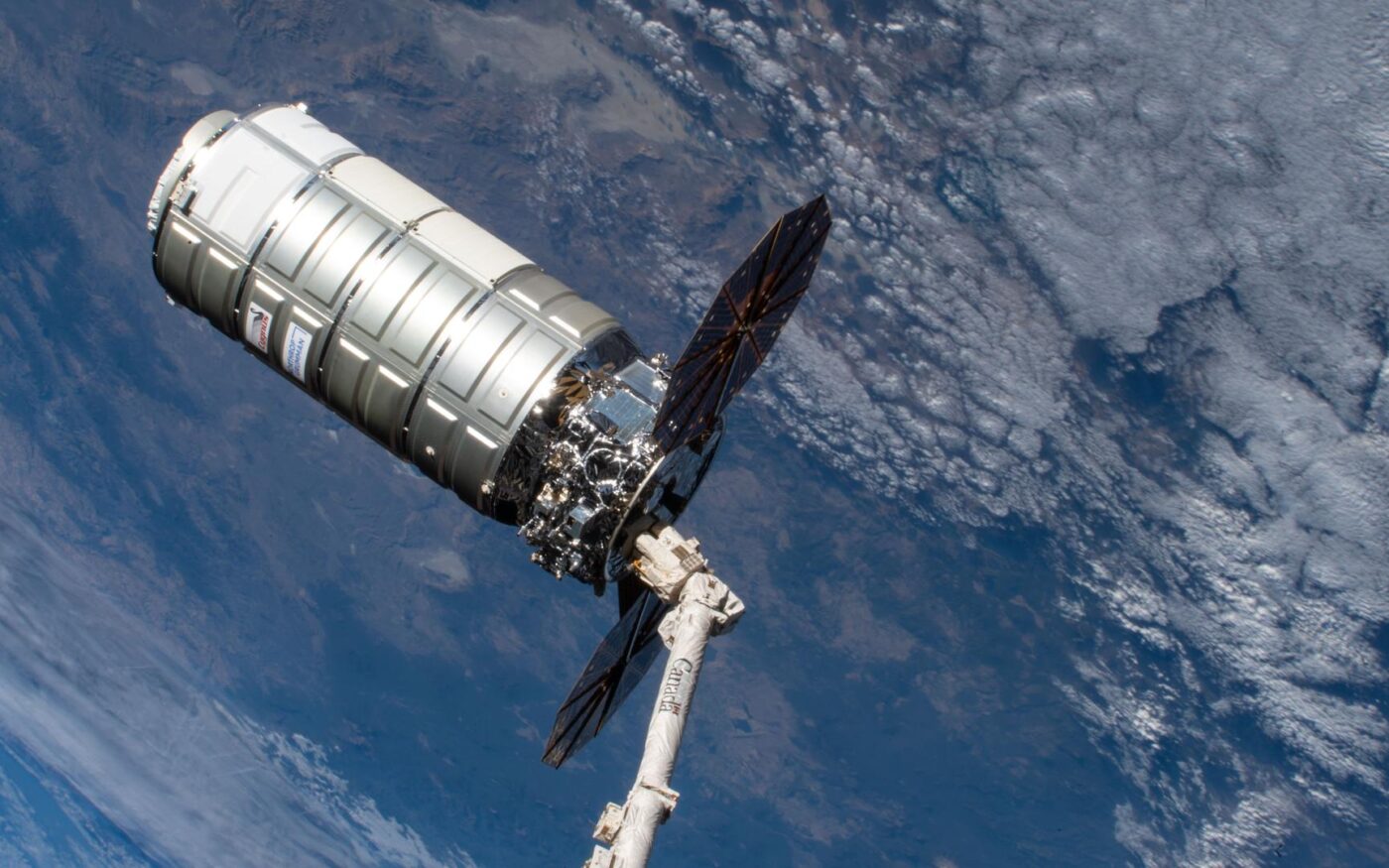
CAPE CANAVERAL, Florida – NASA is targeting November 29 for the launch of a Northrop Grumman Cygnus XL cargo spacecraft carrying scientific experiments, supplies and equipment to the International Space Station (ISS).
The spacecraft, part of NASA’s Northrop Grumman Commercial Resupply Services 25 (CRS-25) mission, is scheduled to lift off no earlier than 10:49 a.m. EST from Space Launch Complex 40 at Cape Canaveral Space Force Station in Florida.

A SpaceX Falcon 9 rocket will carry the Cygnus XL spacecraft into orbit under a commercial resupply contract with NASA.
The mission marks the 25th Northrop Grumman spacecraft built to deliver supplies to the orbital laboratory under the agency’s commercial cargo programme.
After reaching the space station, astronauts will use the Canadarm2 robotic arm to capture the spacecraft and attach it to the Earth-facing port of the station’s Unity module. Cygnus is expected to remain docked until May 2027, allowing astronauts to unload its cargo and support ongoing research.
Among the scientific payloads are experiments aimed at improving drug delivery, understanding cancer progression, studying muscle loss and enhancing radiation monitoring for future space missions.
One investigation will test the manufacture of tiny DNA-inspired particles in microgravity, with potential applications in drug delivery for conditions including cancer and osteoarthritis.
Another study will examine whether biological indicators can help predict the likelihood of cancer spreading to other parts of the body, potentially supporting more targeted treatment decisions.
The spacecraft will also carry human muscle cells and medications for research into treatments for muscle loss associated with spaceflight and ageing on Earth.
A compact radiation sensor designed to improve astronaut safety will also be delivered to the station. The technology could contribute to radiation monitoring on future crewed missions.
The experiments form part of NASA’s broader research programme aboard the ISS, which includes investigations in biology, biotechnology, Earth and space science, physical sciences and technology development.
The space station serves as a microgravity research laboratory, allowing scientists to conduct experiments that would be difficult or impossible to replicate under Earth’s gravitational conditions.
NASA said the commercial resupply programme helps maintain a domestic capability to transport scientific research and equipment to the station, while supporting the development of commercial services in low Earth orbit.
People have lived and worked continuously aboard the International Space Station for 26 years, using the facility to advance scientific knowledge and test technologies needed for longer-duration human spaceflight.
As commercial companies expand their role in providing transportation and destinations in low Earth orbit, NASA is increasingly directing resources towards deep-space exploration, including its Artemis programme and plans for sustained lunar exploration, as part of preparations for future human missions to Mars.