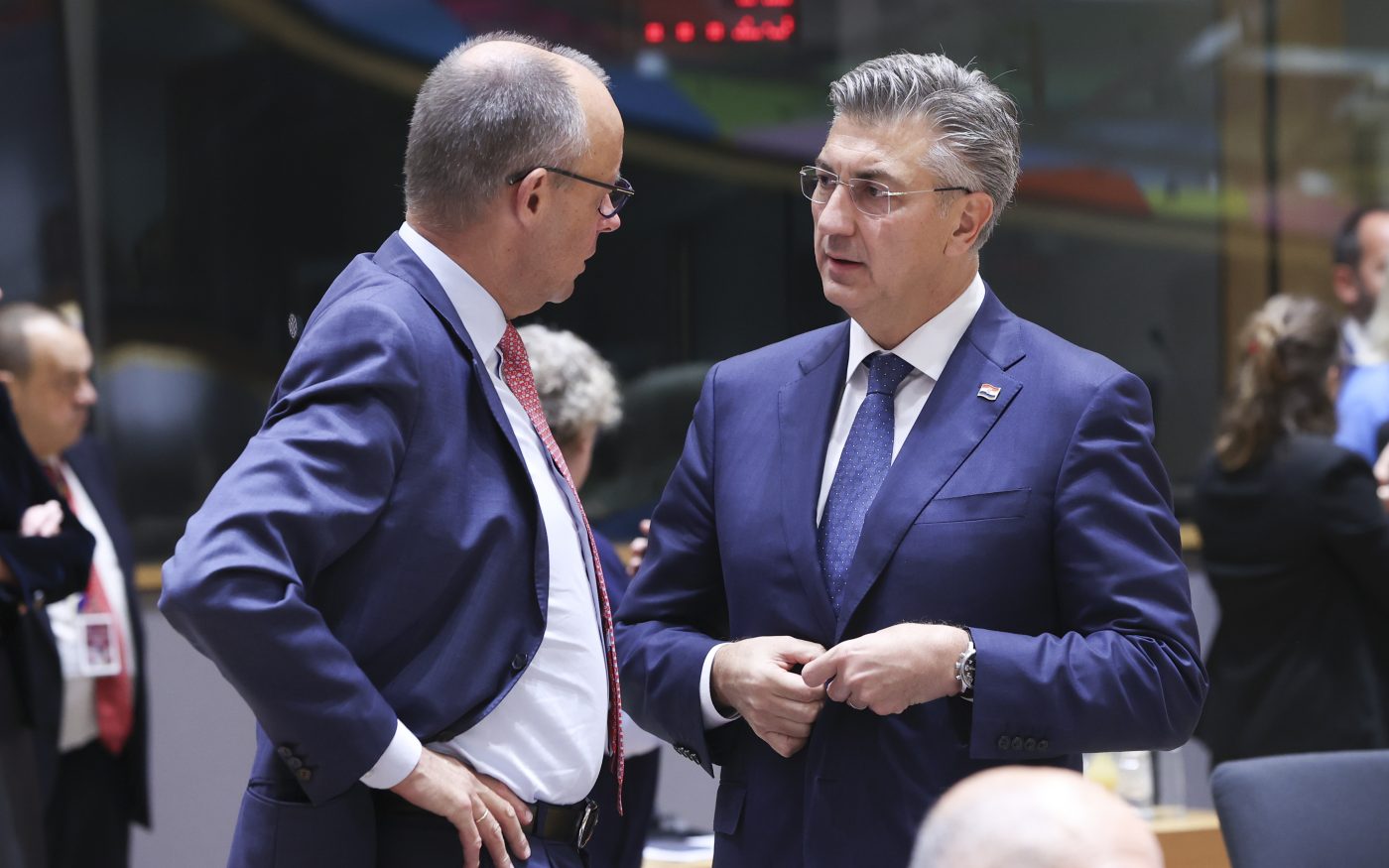
BRUSSELS : German Chancellor Friedrich Merz has called for a significant reduction in the European Union’s proposed long term budget, warning that member states cannot afford the current spending plans and opposing additional funding for agricultural and cohesion policies.
Speaking at the European Council discussions in Brussels, Merz said negotiations over the bloc’s next Multiannual Financial Framework (MFF) remained deeply divided, with member states struggling to agree on the size and priorities of the budget.

“We must significantly reduce the common budget against the Commission’s proposals. No Member State can afford to pay contributions to the EU of this amount,” Merz said.
The Global Envoy’s Rohan Dua was present at the EU Council’s two-day Oct 15-16 summit in Brussels.
He noted that the current proposal was substantially higher than the existing financial framework.
“Just to remind you, the current proposal is 50 per cent higher than what we are funding under the current MFF,” he said.
Merz welcomed the Irish presidency’s proposal as a step in the right direction but said it remained far from what Germany considered acceptable.
“I would like to thank the Irish Presidency for its proposal, which is a step in the right direction, but is still a long way from where they need to be,” he said.
The German chancellor said he did not expect an agreement during the current weekend or in the following days, although he wanted negotiations to conclude by the end of the year.
“We are facing very, very difficult negotiations, and I do not expect us to reach a conclusion this weekend or in the coming days,” he said. “I would like us to reach a conclusion and finalise the MFF by the end of the year, even though views within the EU are very divergent.”
Germany opposes more spending on cohesion and agriculture
Merz said Germany and like-minded member states had put forward proposals to reduce the budget, arguing that the EU needed to reconsider its spending priorities.
Asked how strongly he intended to pursue the cuts, he said unanimity was required in the Council and that agreement remained a long way off.
“Some colleagues want more funding. I am firmly opposed to that. Particularly when it comes to cohesion and agricultural policy,” he said.
He nevertheless stressed the importance of reaching an agreement.
“We need the MFF and should adopt it as soon as possible,” he said.
For Merz, the debate is not simply about the overall size of the budget but also about what the EU should prioritise. He identified competitiveness and defence as the two central areas.
“It is important that we discuss once again the priorities we want to set. In my view, these are competitiveness and defence,” he said.
Merz links budget negotiations to cutting bureaucracy
The chancellor also argued that Europe’s ability to compete depended on reducing excessive regulation and bureaucracy.
He referred to discussions on competitiveness and the single market in Alden-Biesen, where former Italian prime ministers Mario Draghi and Enrico Letta had participated.
“They told us, ‘You need to do more’,” Merz said.
He added that the EU was behind the timetable it had set earlier in the year.
“That is why, in my view, the issues of reducing bureaucracy in Europe and the EU’s finances are very closely interconnected,” he said. “If we do not manage to significantly reduce the excessive bureaucracy in Europe, then there is little point in talking about money.”
Merz said he remained determined to advance the negotiations, despite the divisions among member states.
“Once again, Europe must remain capable of acting and become sovereign, and that is the task we are not sufficiently fulfilling,” he said.
Asked about the prospect of finalising the budget before the end of the year, Merz said the remaining time was short and differences persisted.
“We only have two and a half months left until the end of the year, and we are still very divided,” he said.
His response offered a glimpse of the difficult negotiations ahead: “We should pack a few more shirts than usual for the Council meeting in December.”