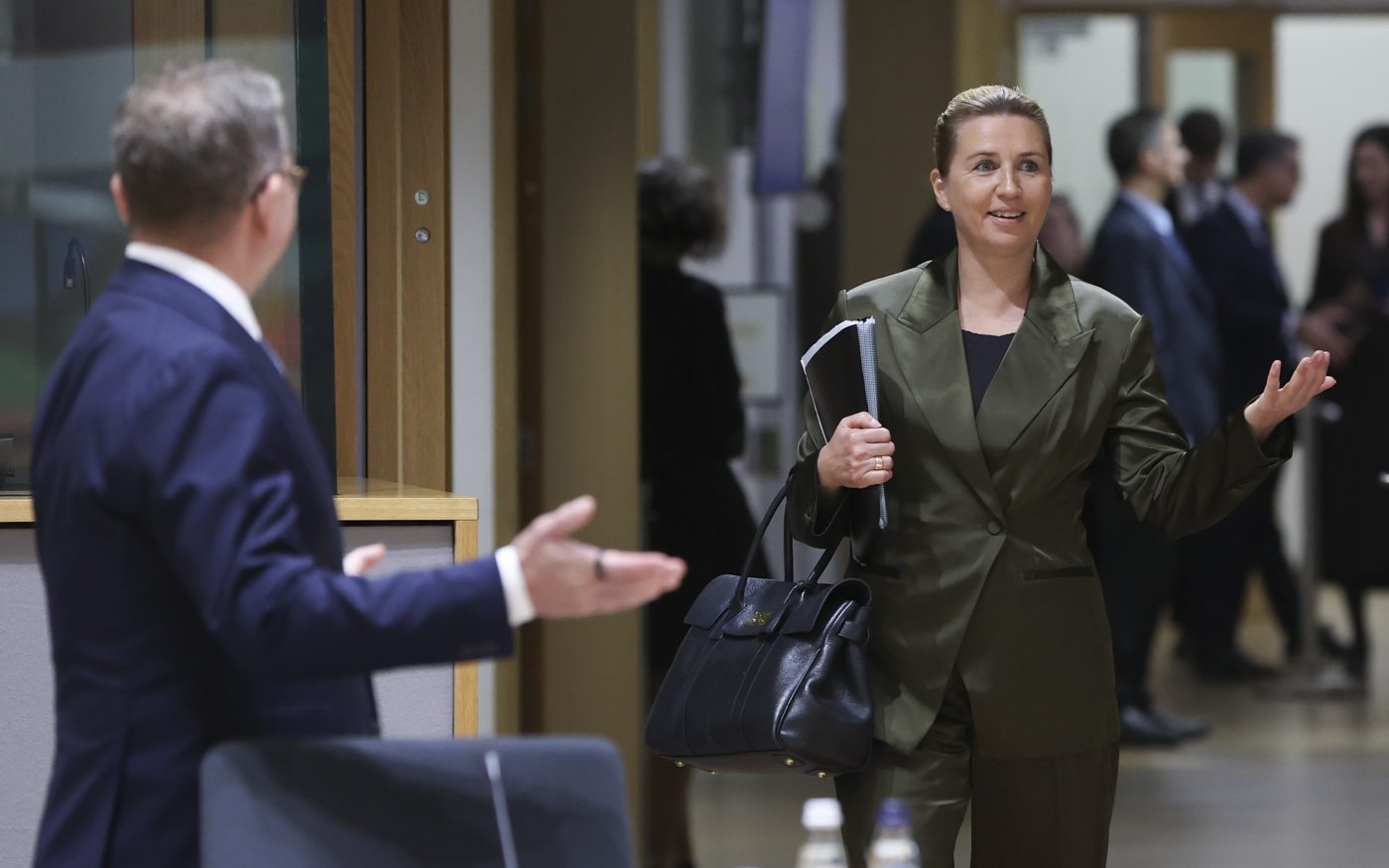
BRUSSELS: Danish Prime Minister Mette Frederiksen warned that Europe’s dependence on external suppliers for energy, technology and critical raw materials was leaving the continent vulnerable, calling for faster efforts to build independent capabilities in defence and other strategic sectors.
The Danish leader raised concerns about Ukraine’s access to Starlink, describing the influence of technology companies as a serious problem.

“It is very problematic and another example of tech giants’ influence,” she said.
The Global Envoy’s Rohan Dua was present at EU council’s two day Oct 15-16 summit in Brussels to report on congregations’s agenda.
Frederiksen said Europe faced a more difficult geopolitical environment following developments involving the United States and Ukraine, while rising migration pressures and competition from China were adding to the challenges confronting the bloc.
She described the signals from the United States concerning Ukraine as extremely serious and said Europe was in a worse position than it had been only days earlier.
Frederiksen said Europe needed to find financing for Ukraine in the coming days and warned of the consequences of failing to sustain support for Kyiv.
“I reiterate if we let Ukraine fall, we open the doors for Russia in other places of Europe,” she said.
She argued that the issue reflected a wider problem of European dependence on external powers.
“Our dependency on others is a general problem for Europe: fossil fuels, technology, critical raw minerals,” she said, adding that the continent was in a hurry to create alternatives, including in defence capabilities.
Europe must be able to defend itself by 2030
Frederiksen said Europe should develop the capacity to defend itself by 2030, acknowledging that doing so would come at a cost.
“Europe should be able to defend ourselves by 2030,” she said. “It will have its costs, but it is necessary.”
She called for Europe to become more capable in technology and energy, as well as in defence, to reduce its vulnerability to external pressures.
On energy, Frederiksen argued that Europe needed to become less dependent on fossil fuels, warning that purchases from Russia helped finance the Russian war effort.
“When we buy from Russia, we finance the Russian war machine,” she said.
She also said Europe should continue dialogue with China but remain prepared for the possibility that Beijing would not honour its commitments.
“Dialogue with China is good, but China is not known for keeping their words, so we need to be ready for that,” she said.
Frederiksen’s comments linked the immediate need to finance Ukraine with a broader strategic objective: ensuring that Europe can protect itself and maintain access to essential energy, technology and raw materials.
For Denmark, the challenge is to accelerate that transition while securing agreement on the EU’s next long-term budget and the funding needed to strengthen Europe’s defence and competitiveness.