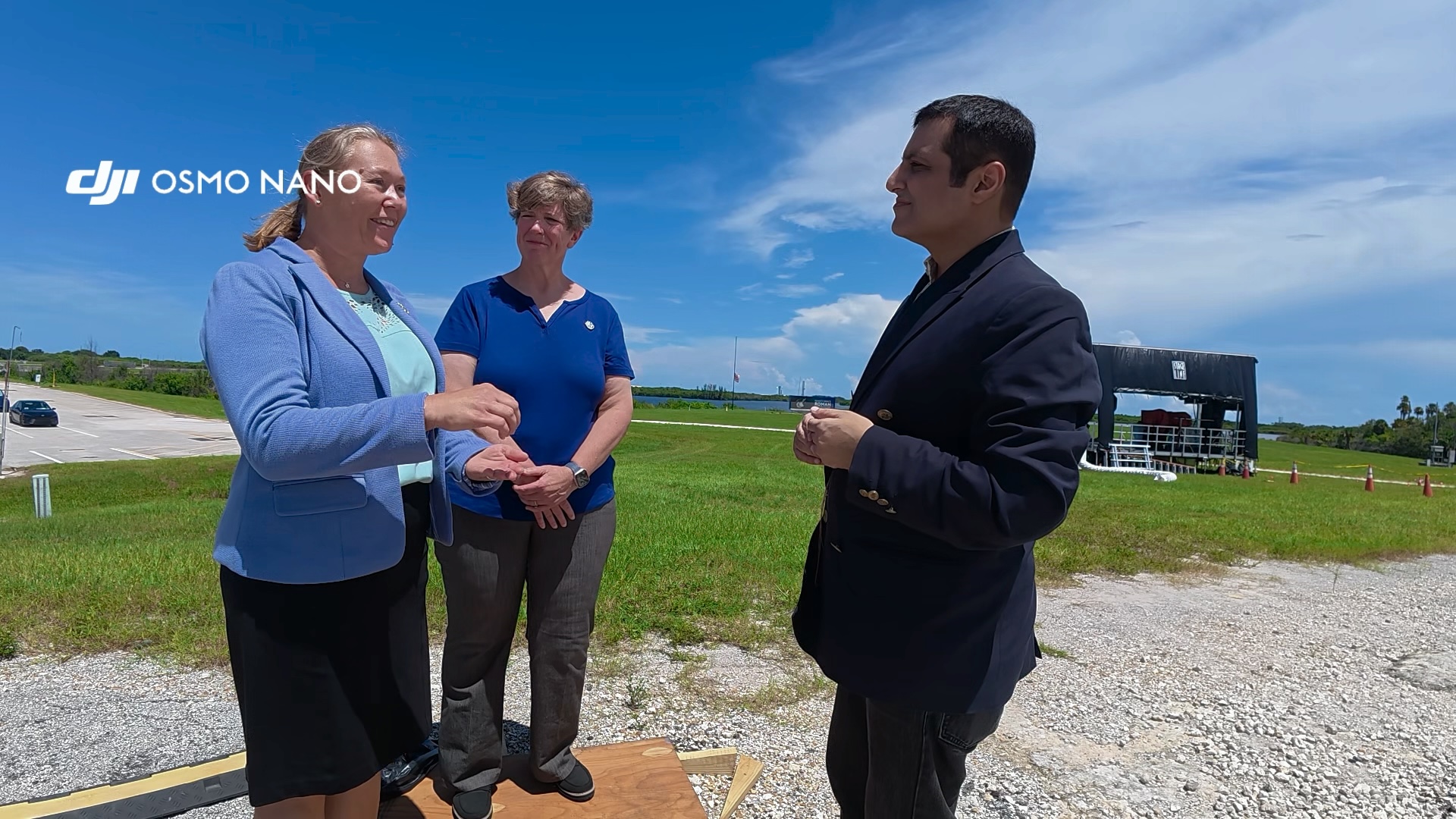
KENNEDY SPACE CENTER, CAPE CANAVERAL (FLORIDA): As NASA launched its iconic Nancy Grace Roman Space Telescope, an observatory designed to help scientists investigate dark energy, study the universe’s evolution and search for planets beyond our solar system, into the space, British Aerospace Systems couldn’t contain their joy on their contribution.
In an interview with Rohan Dua for The Global Envoy at NASA’s Kennedy Space Center facility in Cape Canaveral, BAE Systems representatives Sarah Lipscy and Bonnie Patterson discussed the company’s longstanding partnership with NASA, their role in the mission and the significance of naming the telescope after pioneering astronomer Nancy Grace Roman.

BAE Systems worked with NASA’s Goddard Space Flight Center to develop the telescope’s primary instrument, bringing together components from both organisations.
“We’re super proud of the contribution that we’ve made to the primary instrument for Nancy Grace Roman,” Lipscy, Director, International Business Development within the Space & Mission Systems sector, BAE Systems told Rohan Dua.
The instrument was developed jointly by the company and NASA Goddard, with testing conducted at BAE Systems’ facility in Boulder, Colorado.
“We developed it together, bringing two components from both institutions together, and jointly tested it in our facility in Boulder, Colorado,” Lipscy said.
The collaboration drew on the organisations’ experience working together on space technology projects, the representative added.
“We lean very heavily on our many decades of experience partnering with NASA to really bring that collaboration to the successful outcome that it has,” Patterson, Vice President and General Manager for Civil Space at BAE Systems, said.
The Roman telescope builds on the legacy of Hubble, which transformed astronomical research and brought images of distant galaxies and other celestial objects to audiences worldwide.
With a much wider field of view than Hubble, Roman is expected to collect data across large sections of the sky, helping scientists study how the universe has evolved and investigate the forces driving its expansion.
The mission also reflects the contribution of engineers and technology companies to NASA’s scientific programmes, with complex instruments requiring years of development, integration and testing before they can operate in space.
For BAE Systems, the project represents another milestone in its longstanding work with NASA. For astronomers, the observatory is expected to provide a new set of tools to explore questions about the structure and history of the universe.
By carrying Roman’s name, the telescope will also honour the scientist whose work helped make modern space-based astronomy possible.
“We’re incredibly proud that NASA picked the name Nancy Grace Roman for the Space Telescope,” Lipscy, said.
“To name an observatory of this importance after a woman who was also critical to NASA’s history is amazing,” she added.
Nancy Roman played a leading role in advancing space-based astronomy at NASA and helped establish the foundations for the Hubble Space Telescope. She became widely known as the “Mother of Hubble” for her contributions to the development of space astronomy.
Lipscy said the observatory would help future generations better understand the universe.
“We look forward to being able to use this observatory to help future generations understand our place in the universe,” she said.
“And the fact that we’ll be able to tie those data to Nancy Grace Roman is just an amazing accomplishment.”
The Roman Space Telescope is designed to survey large areas of the sky, complementing the observations of telescopes such as Hubble. Scientists expect its observations to help investigate dark energy, map the distribution of galaxies and identify planets orbiting distant stars.