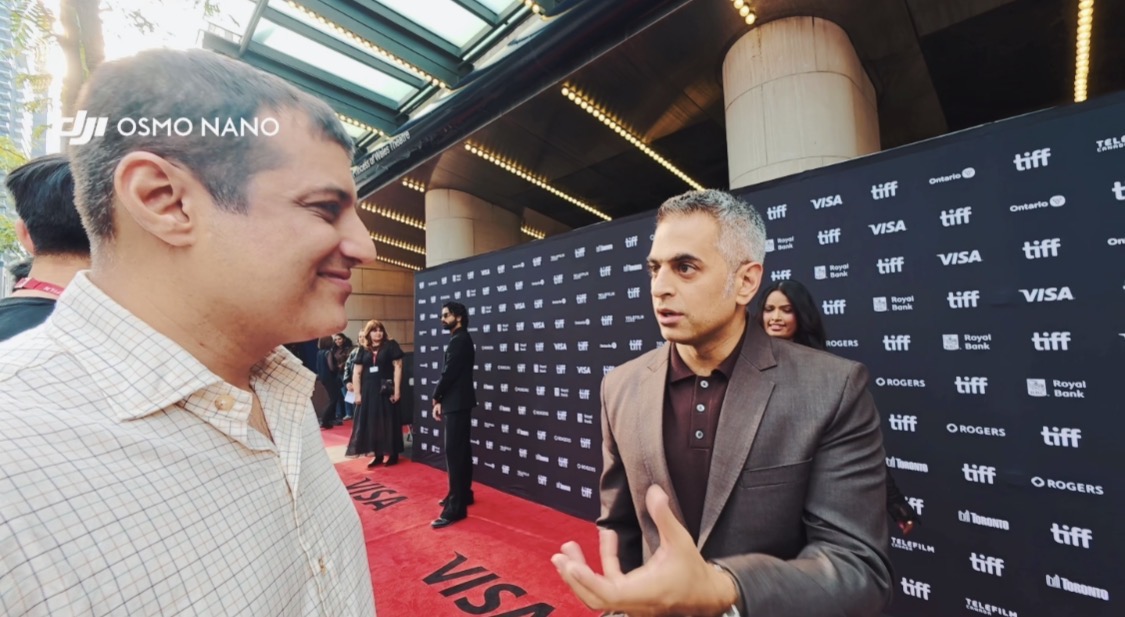
TORONTO: Renowned film and OTT producer Richie Mehta did not immediately believe he was the right person to tell Phoolan Devi’s story.
The filmmaker behind Delhi Crime, the acclaimed series that revisited one of India’s most disturbing criminal cases, had reservations when producers approached him with the idea of bringing the life of the controversial Indian political figure to the screen.

“I disagreed,” Mehta recalls. “I’m a Punjabi boy from Toronto, why am I the right person?”
Speaking to Rohan Dua for The Global Envoy at the Toronto International Film Festival (TIFF), Mehta described how a project he initially questioned became a story he felt compelled to tell.
The producers at Adnama Pictures had acquired the rights to Phoolan Devi’s autobiography from her family and approached him after the success of Delhi Crime, convinced that he could introduce her life to a new generation.
They persisted. Mehta read the book, and his doubts began to give way to a sense of responsibility.
“I was so moved by it, as you would know,” he says. “And I said to myself, if no one’s going to do this today, I’ll take it up.”

It would take several more years to find the version of the story he believed was right.
Phoolan Devi’s life has long resisted simple interpretation.
Born into a poor family in Uttar Pradesh, she became a figure associated with caste oppression, violence and rebellion before entering Indian politics as a Member of Parliament. Her transformation from outlaw to elected representative made her one of the most contested figures in modern Indian public life.
For Mehta, whose work often examines the relationship between individuals, institutions and society, the challenge was to find a way of approaching that history for contemporary audiences.

The starting point was not an attempt to recreate the mythology surrounding Phoolan Devi, but the autobiography that had moved him enough to reconsider his initial reluctance.
At TIFF, the conversation about the film also became an opportunity to revisit the realities that remain around Phoolan Devi’s legacy, long after her rise to national prominence and her death.
The village behind the legend
Phoolan Devi is not simply a historical figure or a character in a film. As Dua recalled how as a journalist, he has reported on her life and the communities associated with it, including in the Kanpur region and Kanpur Dehat during 2024 Lok Sabha elections, Mehta was astonished.
During a visit to her village in 2024, Dua met Phoolan Devi’s elderly mother while reporting for The New Indian.
Her mother, then about 89, was frail but continued to recall memories of her daughter.
The village, situated on a hilltop in the Kanpur Dehat region near a river, offered a striking contrast to the national attention Phoolan Devi had once commanded. Dua recalled being shocked by accounts that the family was struggling to obtain food grains.
The encounter raised an uncomfortable question: what happens to the people and communities behind a celebrated public figure when the attention moves elsewhere?

Phoolan Devi’s story had travelled from rural Uttar Pradesh to the national political stage, but the circumstances Dua encountered during his reporting suggested that her family’s struggles had not necessarily been transformed by her public prominence.
Mehta acknowledged the significance of such experiences when Dua raised them during their conversation, saying they were among the reasons he had wanted to meet the journalist.
The exchange underscored the distance that can separate a public legend from the everyday lives of the people connected to it. Phoolan Devi’s image has been shaped by accounts of violence, resistance and politics, but her story also belongs to the family and the rural world from which she emerged.
For a filmmaker attempting to bring that life to a new audience, those complexities form part of the larger challenge of deciding what to show, what to emphasise and how to approach a figure whose legacy remains deeply contested.
From Delhi Crime to Phoolan Devi
Mehta’s move from Delhi Crime to Phoolan brings him back to difficult subjects rooted in India’s social realities.
Delhi Crime, which examined the aftermath of the 2012 Delhi gang rape, attracted international attention for its treatment of a case that had triggered widespread public anger and scrutiny of the criminal justice system.
The series also showcased Shefali Shah, whose performance as a police officer became central to its impact. During the conversation at TIFF, Mehta spoke about her while replying to a query by Dua on his memories of working with the actor.
The filmmaker was effusive.
“Oh my god, my pleasant memories, I have so many I wouldn’t even know where to start,” he says.
Mehta recalled that Shah approached her character with a level of commitment that impressed him from the outset.
“She took on that character in a manner where I wasn’t sure anyone on earth could,” he says, praising her diligence and hard work.
At their first meeting, Shah told him she had around a thousand questions about the role. Mehta encouraged her to ask as many as she needed.
“She (Shefali) had about 10,000 questions,” he says, adding that they were all pertinent.
The preparation was so intensive, he recalls, that “she ended up directing herself”.
The anecdote offers a glimpse into the collaborative relationship between a filmmaker and an actor, and the importance of detailed preparation when dealing with characters whose lives and experiences carry considerable emotional and social weight.
For Mehta, Shah’s approach demonstrated how an actor can take ownership of a role, interrogating its details rather than simply relying on a director’s instructions.
Taking Phoolan to a global audience
At TIFF, Mehta was looking beyond the festival to the next stage of the film’s journey. His immediate hope was that Phoolan would reach audiences around the world through its planned release on Prime Video.
Asked by Dua what he hoped would happen when the film reached audiences in India and internationally, Mehta said he was looking forward to Amazon MGM Studios releasing it on the streaming platform.
“I’m just looking forward to Amazon, Amazon MGM Studios releasing my film on Prime Video and getting it out to the world,” he says.
For now, however, he is concentrating on whether the film communicates what its makers intended.
“I just want to make sure this plays properly, it’s technically expressing everything we want to express,” he says. “And then after that I see what happens.”
There is a certain restraint in that answer. Mehta had taken years to arrive at a version of the story he felt comfortable telling, after initially questioning whether he was the right person to undertake it. He now appears content to let the finished work make its own journey.
Phoolan Devi’s life continues to raise questions about caste, gender, violence, political representation and the making of public heroes. Her journey from rural Uttar Pradesh to Parliament remains extraordinary, but it is also a story that cannot be separated from the inequalities and conflicts that shaped it.
For Mehta, the decision to make the film began with an autobiography and the realisation that he had been moved by a story he had initially hesitated to tell.
At the Toronto International Film Festival (TIFF), the filmmaker was preparing to send that story into the world. What audiences make of it, he suggested, is the next chapter; one he is willing to leave open.